
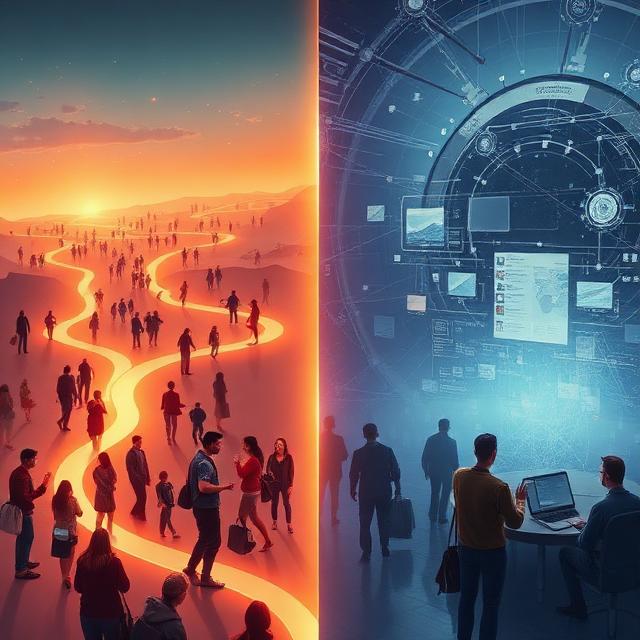
How Algorithms Replaced Human Discovery on the Internet | Why the Web Feels Less Social
When We Stopped Discovering People and Started Consuming Algorithms
The internet didn’t lose its human touch overnight. It happened one design decision at a time.
The early web wasn’t just a collection of websites—it was a network of people. We navigated it by following curiosity, shared humour, recommendations, and niche communities. One interesting person led to another, one blog linked to another, one forum introduced you to a dozen more.
The equation was simple:
Find people → Discover content
Today, that equation has quietly reversed.
Algorithms find content → Maybe you discover people
Instead of actively exploring, we increasingly consume what recommendation systems decide is worth our attention. Discovery has shifted away from human networks and toward mathematical optimisation. Convenience has increased, but something important has been lost along the way.
A telling example of this shift is X’s decision to hide public likes.
At first glance, the change made sense. Public likes could expose users to criticism, harassment, or unwanted scrutiny. Improving privacy is a legitimate goal.
But every design decision comes with trade-offs.
A “like” was never just an approval metric. It was a digital footprint—a small signal that revealed how people connected with ideas, humour, and each other. Those footprints created invisible bridges across the platform.
When those bridges disappeared, so did one of the internet’s simplest forms of human discovery.
The “Vibe Check” Disappeared
One of the fastest ways to find like-minded people was to look at who liked a niche post.
The post itself was only the starting point. The list of people who appreciated it often revealed an entire community with the same obscure interests, sense of humour, or worldview. It was an organic directory of humans rather than a list generated by software.
Today, that trail ends at the post itself.
Profiles Became Walled Gardens
Public likes also transformed individual profiles into discovery engines.
If you respected a writer, developer, artist, or researcher, browsing what they liked often led you to independent creators and conversations the algorithm would never have recommended.
Taste was contagious.
Now, profiles are far more isolated. They show what someone creates, but reveal far less about what influences them.
Discovery Became Algorithmic
Hiding public likes wasn’t the single event that changed the internet.
Chronological feeds disappeared. Recommendation engines became dominant. Search became increasingly personalised. Social platforms optimised for engagement instead of exploration.
The removal of public likes simply symbolised a broader structural shift.
Each change reduced opportunities for people to discover one another directly while increasing reliance on algorithmic mediation. Gradually, platforms stopped asking, “Who might you want to meet?” and started asking, “What content is most likely to keep you scrolling?”
That difference matters.
Algorithms are exceptionally good at predicting what will hold our attention.
They are far less effective at recreating the serendipity that came from wandering through another person’s interests.
The internet once felt like walking through a city where every conversation, recommendation, and shared joke could lead somewhere unexpected.
Today, it increasingly feels like walking through a shopping centre where every turn has already been calculated.
Privacy is important. Better safety is important.
But information architecture isn’t neutral. The way platforms organise information also determines how people discover one another. Every interface encourages some behaviours while quietly discouraging others.
When we remove the small human signals that connect strangers, we don’t just change a feature—we change the way communities form.
The web works best when it helps people find people.
Not when it simply decides what they should see.